This post may contain affiliate links, which means I may earn a small commission if you buy through my link but does not change your price.
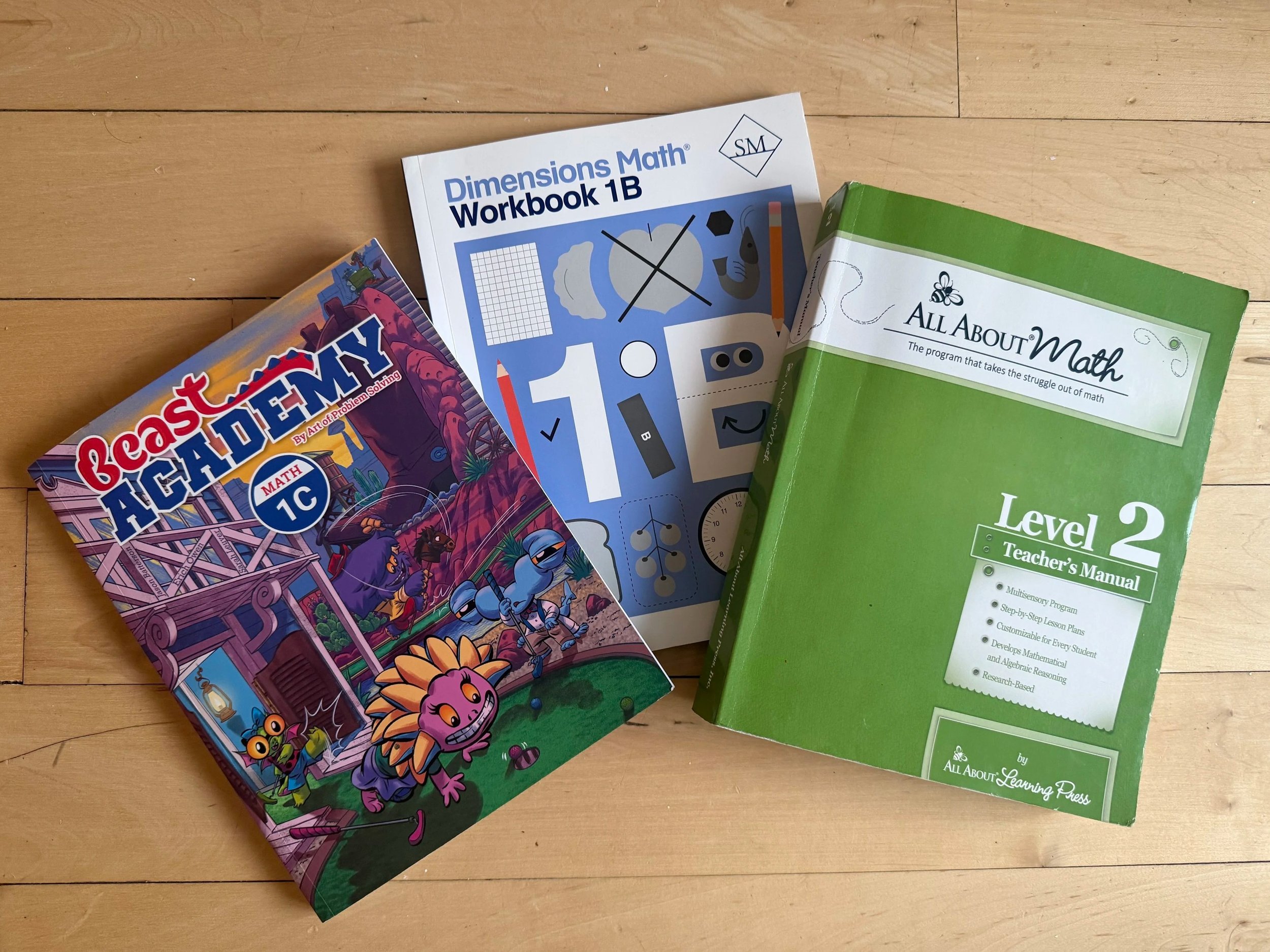
I don’t know whether to be embarrassed or somewhat proud that we have tried 5 different math curricula for my barely 5-year-old so far. And no, we didn’t just try each of them for a few days. We got through at least half a year of each of these curricula. Yes, this is a lot of switching. But it was important to me to find the curriculum that was the best fit for my son. I actually feel every curriculum we have tried has given my son something. I don’t regret any of them! We also never switched because he disliked the curriculum. In fact, he did very well and enjoyed them all! We switched simply because I was looking for something that could meet his needs a bit better. He is young and quite far ahead in math so I feel we have the luxury of time on that. Our main goal is to go for greater depth, not speed through curriculum levels.
In this blog post, I am going to discuss my experience with each of the five curricula and, ultimately, why I think we finally found the right fit for my son. His needs, like the needs of every student, are unique. There is no one right curriculum, so I hope to share a small review of each to help people decide what might be best for their child.
Montessori Math
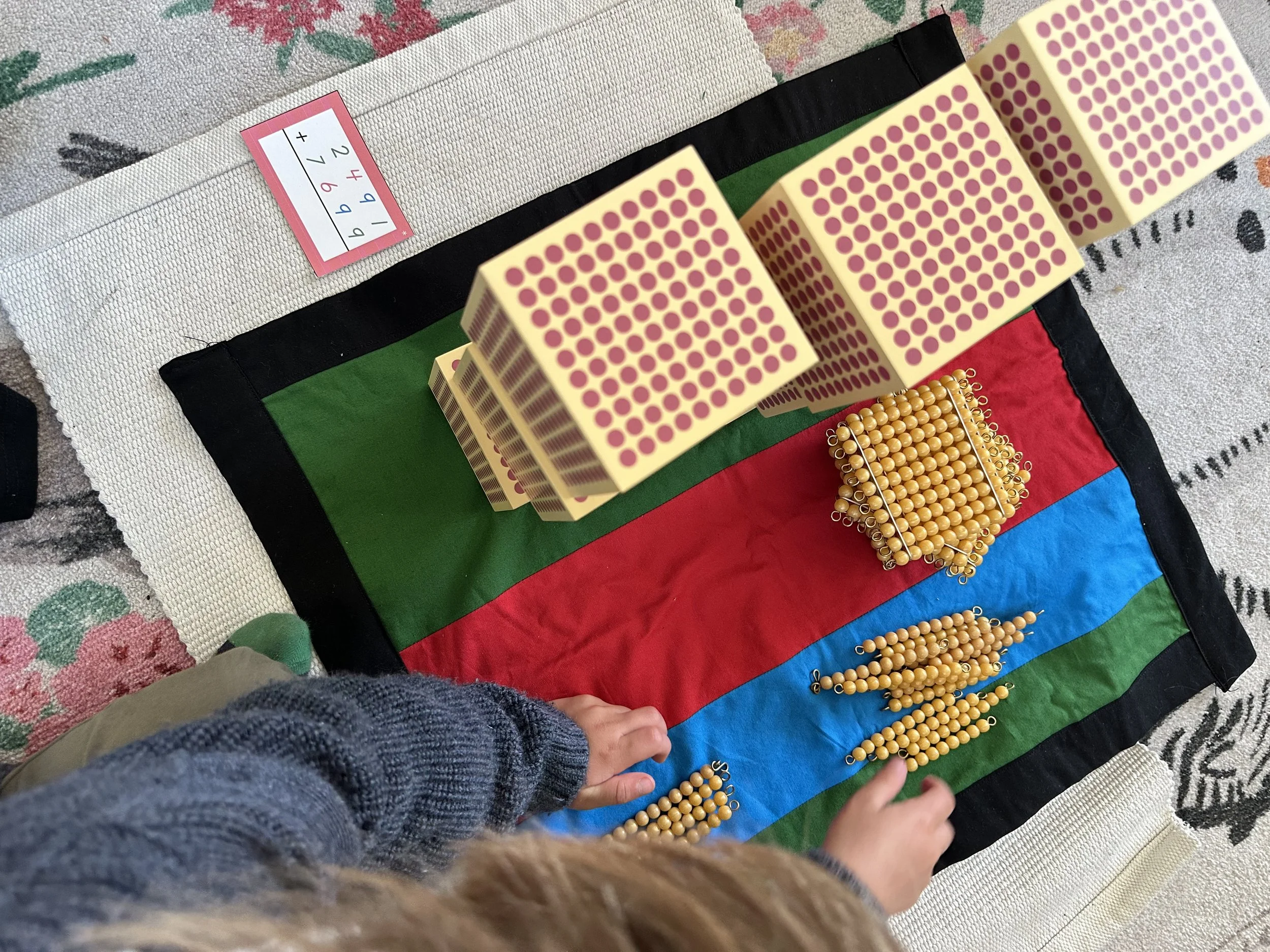
I love Montessori math. Montessori math does an incredible job of moving from concrete to abstract through didactic materials such as the golden beads. I credit a lot of my son’s very strong number sense to all the hands-on work with Montessori materials. I used Montessori materials to teach numbers up to 9,999, to teach addition and subtraction, and to teach addition math facts.
We still use Montessori materials for teaching new concepts, but at some point, when my son was about 3.5, I also wanted a more open-and-go curriculum. I have found combining an open-and-go curriculum with Montessori math to be a perfect combination in our home. The downside of Montessori Math is the need for materials. We do not have all the materials, but we have some of the major ones. We have the colored beads, the Hundred Board, the golden beads, and the stamp game. These materials can be combined with printable materials from Teachers Pay Teachers. A solid course on Montessori math makes teaching it much more doable. I love the course from Angela Momtessori because it is straightforward, no fluff, and affordable.
My daughter, now 3, is doing Montessori math now.
Math With Confidence
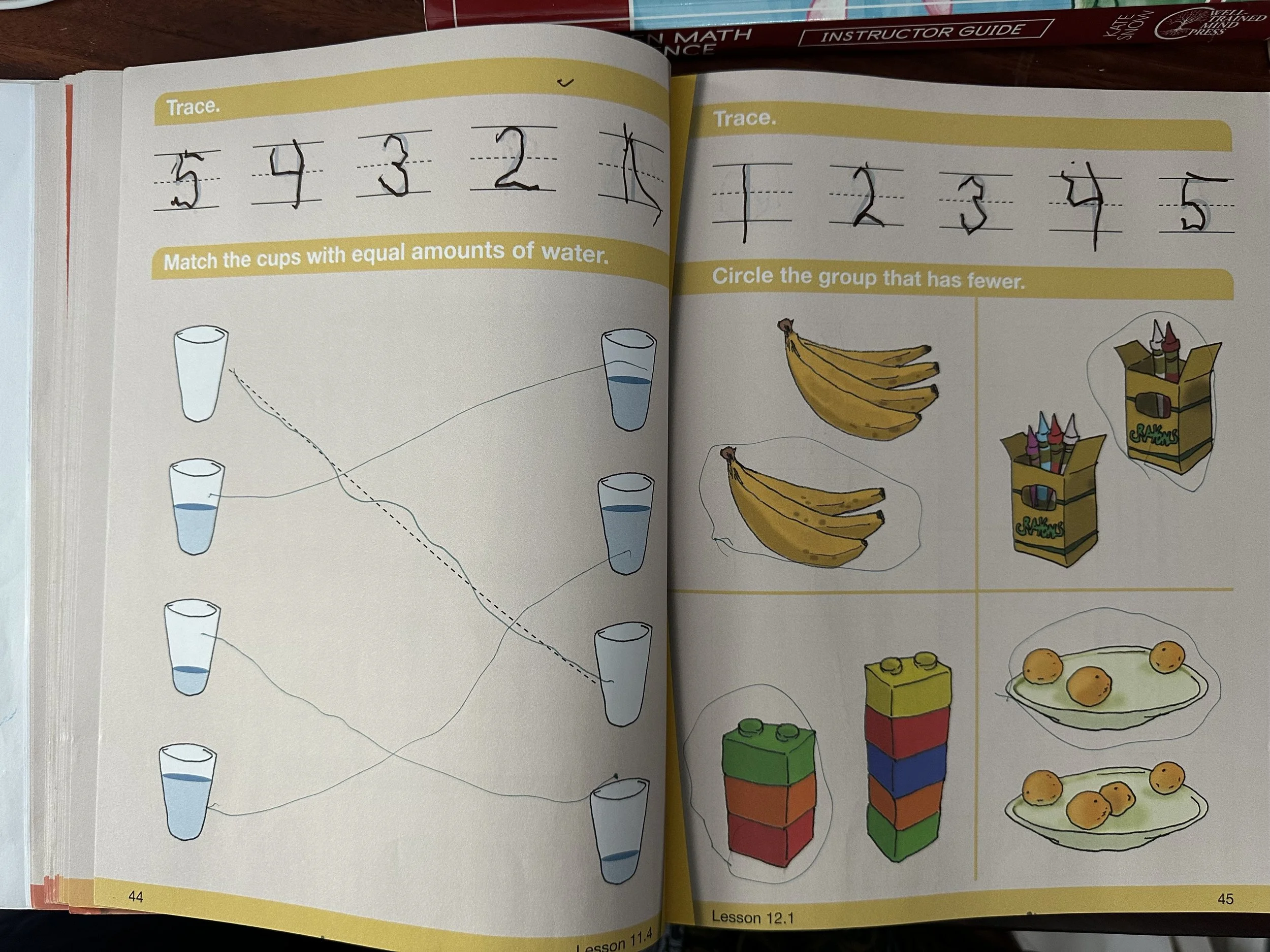
The first open-and-go style curriculum we tried was Math With Confidence. We had done the book Preschool Math at Home from the same author (Kate Snow), and my son had learned a lot of math from it, but by 3.5, it was much too easy. I was looking for something open-and-go with minimal writing. Math With Confidence Kindergarten fits the bill. From what I saw, it had less writing than Singapore and a lot of hands-on experiences. In fact, a good deal of the writing in Kindergarten Math With Confidence is dedicated to tracing numbers.
We loved Math With Confidence for all the connecting activities. We played lots of games and had a lot of fun together. There is a workbook, but very little of the actual learning is in the workbook. In fact, my son plowed through the workbook, always wanting more workbook pages. Each day has a very, very small amount in the workbook, at least at the Kindergarten level. If you look at the page I showed, you can see that only one of those pages is a day. That is very little workbook work.
Math With Confidence is a well-rounded, but gentle curriculum. In the end, it turned out to be too gentle for my math-y son. He wanted more, and it wasn’t moving at the speed or the depth we needed. My goal is not to accelerate him through years of math. My goal is to offer the greatest depth I can each year. Though we only used the Kindergarten level, my understanding is that First Grade has a lot of review and is very gentle as well. That said, there is so much Math With Confidence does well. I particularly love Kate Snow’s emphasis on subitizing. She takes that very seriously, and my son’s skills in that from all the Math With Confidence practice are incredible. He can subitize much better than I can, and I firmly believe this is something to work on early. I do not believe, as an adult, I can ever rewire my brain to have that skill as strong as my son does, who wired it early. Math With Confidence is research-backed. I don’t want anyone to think that because it wasn’t the best fit for us, that it isn’t an incredibly solid program. Math With Confidence does an incredible job. I just don’t know that it is the best fit for a child who is more advanced in math, at least on its own.
For Math With Confidence, you need the teacher’s guide and the workbook for each level. I see people in homeschool groups on Facebook all the time asking if they need the teacher’s guide. You absolutely need the teacher’s guide for Math With Confidence. It is not a complete program at all with just the workbook. The workbook is very little of the program and not where the teaching is happening.
While I ended up moving on from Math With Confidence with my son, I very well may do the Kindergarten level again next year with my daughter. I thought it was a great foundation before moving on to a more rigorous program.
Singapore Dimensions Math
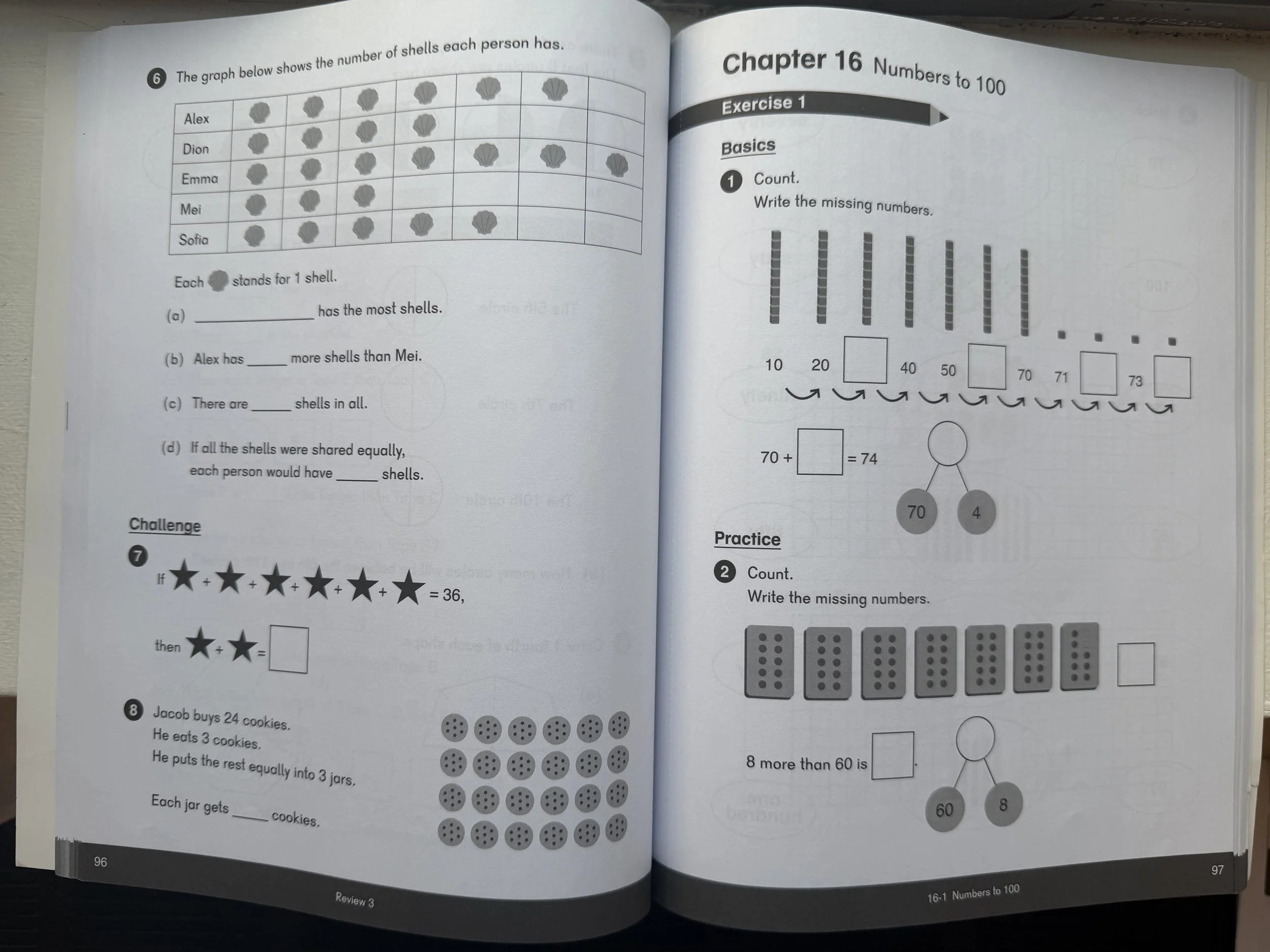
Following Math With Confidence Kindergarten, I decided not to continue with Math With Confidence. We finished the entire year in only a few months, and I did not want to be rushing through years of math. Instead, I decided we would try Singapore Dimensions. Singapore is known for its concrete to pictorial to abstract system of learning, a method Math With Confidence also employs. Singapore Dimensions Kindergarten was definitely less gentle than Math With Confidence. It includes more workbooks and some deeper abstract understanding. Because of that, I decided to go back and get the KB workbook for my son to prep before starting 1A. At this point, he was a little over 4 and could handle the bit more writing that Dimensions has. He breezed through the KB workbook, but I was very glad we started there. He learned how Singapore works and was very ready when we started 1A.
At first, my son really enjoyed Singapore. I will say the K books are much more engaging than the First Grade ones because they are in color, but he did like the First Grade ones at first. We were doing it alongside All About Math, and it provided workbook work for him (which he has always enjoyed). I love that many sections have challenge problems that go deeper. However, over time, my son started to get bored. There is a lot of repetition in Singapore, and he does not necessarily thrive with too much repetition. There were generally 4 or 5 workbook pages per lesson in first grade (I think slightly less at the Kindergarten level). He was loving the challenge problems but finding the repetition of the others boring. We were both wishing there were more challenge problems. Often, there would be only a couple challenge problems, and he would love them but want more. I was a bit disappointed in the Intensive Practice books we got to go along with Singapore. It didn’t feel like they quite hit what we needed for a challenge. At this point, I was talking to a friend who recommended Beast Academy if Singapore was not challenging enough. I hesitated for a bit because I was skeptical about the comic style, but ultimately we made the switch. My son still does Singapore worksheets for independent work at times (when he wants), but we skip a lot, and I don’t use the Singapore teacher’s guide for teaching at all. I absolutely think I could have made Singapore work really well for my son, especially when used alongside All About Math, but ultimately, it wasn’t our perfect fit program.
For Singapore, you need the teacher’s guide, textbook, and workbook, along with manipulatives. Each level is divided into 2 parts (a and b). The necessity of 3 different books feels very excessive to me and was one of the things I did not like about Singapore. I don’t mind the two parts of a year, that is necessary for the amount of practice they provide, but I feel they could have consolidated something to only have a teacher’s guide and workbook like most programs.
All About Math
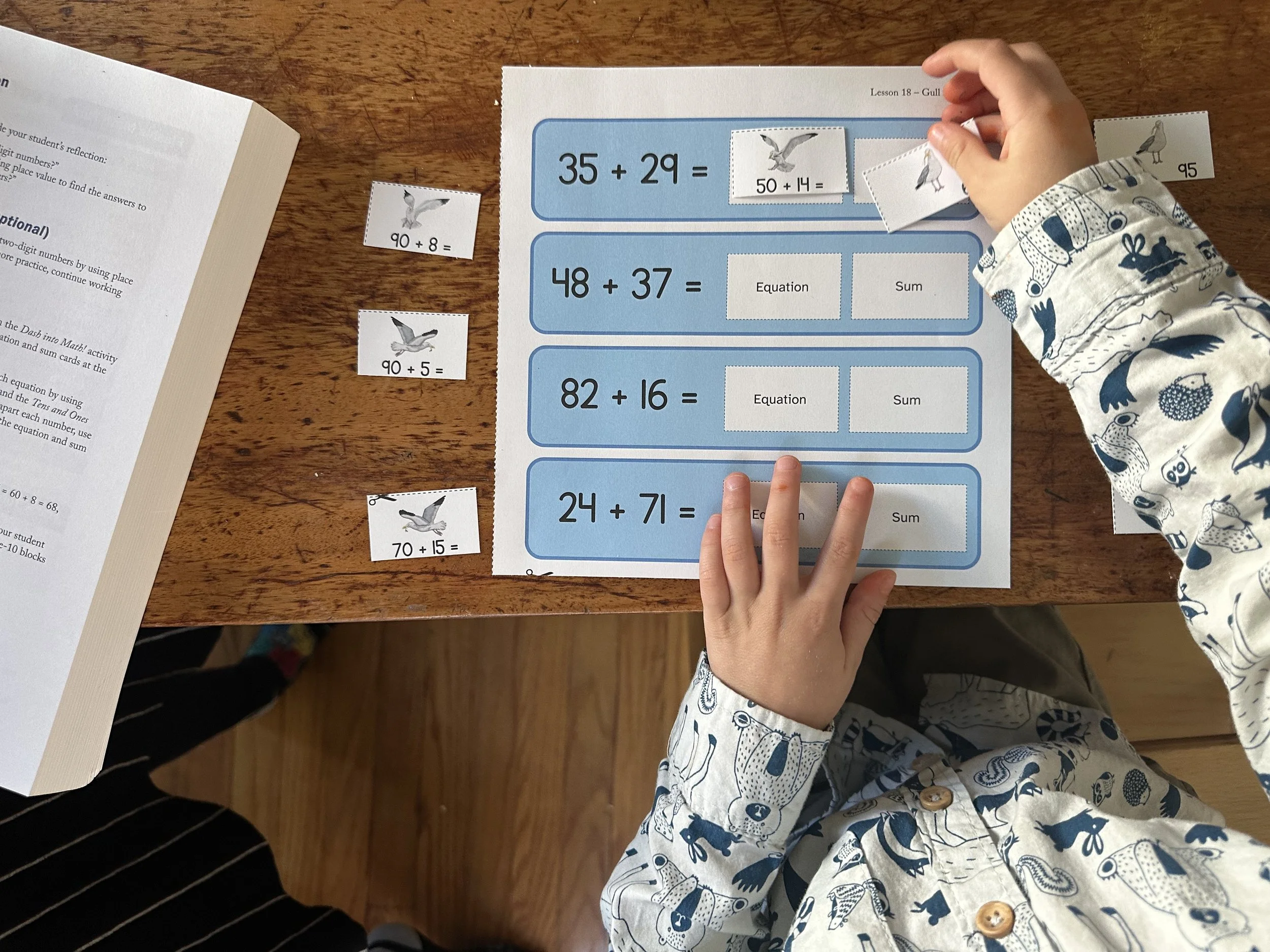
All About Math is what I wished existed when my son was 3.5 and ready for a bit more of a formal curriculum. At that time, I was googling “All About Reading but for math” and was led to Math With Confidence. All About Math came out almost a year later, and at that point, my son was ready for level 2. All About Math is from the same company that makes All About Reading, which our family adores.
We really enjoyed All About Math, but I will say All About Reading is definitely our favorite from the All About Learning company. I still wish All About Math had been out the year prior because I think level 1 would have been absolutely perfect for him at the time. I am now debating whether to try All About Math Level 1 with my daughter next fall (or do Kindergarten Math With Confidence again, since I would just need the workbook). We started my son with level 2, and overall, I feel really positive about it. I have a whole blog post on our experience with it, but I will share some here as well.
I love that it really deemphasizes workbook work. In fact, it has much less writing than even Math With Confidence. This makes it ideal for an advanced younger student. It is incredibly hands-on and multi-sensory. At the same time, it seems to move a bit faster. I found my son was able to be challenged in All About Math in a way that he wasn’t in Math With Confidence. All About Math places a huge emphasis on story problems and moves into bigger numbers faster. From what I see, it seems All About Math takes a bit of a middle ground between Montessori and many of the traditional math curricula. It does not move into numbers up to 9,999 as quickly as Montessori, but it does move into bigger numbers much more quickly than any other standard curriculum we tried. On the flip side, All About Math does not expect children to be doing math in their heads quite as quickly as Singapore, for example. For my son, who was doing more mental math, the move to larger numbers more quickly was actually wonderful. From my perspective, this allows a curriculum to be differentiated a bit more for an advanced learner.
I would worry a tad that All About Math, if done without a supplement workbook, would not set children up for success with independent work later. I truly believe one-on-one instruction is teaching gold, but I also think there is value in children learning how to do work independently as well. I have not tried the upper levels of All About Math, but I do not believe they introduce a workbook either (though maybe they have another form of independent work!). I don’t think workbooks are necessary in the early years, but programs like Montessori math allow independent work in a different form, which All About Math level 2 did not.
All About Math is very teacher-intensive. I do believe that a lot of teacher involvement is important in early math, but it is really teacher-intensive. For us, I found that once I started doing All About Reading with my daughter, All About Math felt harder to fit in. If you are looking for a more hands-off approach to teaching math, this is not it. In addition to teaching, there is a lot of cutting up little bits of paper for activities. The teaching itself is scripted, but there is prep required before. Could I have done both All About Math and All About Reading at the same time? Absolutely! But, since my son was preferring a different curriculum anyway, it made sense for us to let it go for now.
All About Math is also not strictly grade-based. I believe level 1 is generally Kindergarten work with a bit of first grade. Level 2 covers first into second, then 3 is third, etc. I think the idea is that after 5 levels, you would move into pre-Algebra. They offer a placement test. As with All About Reading, their program is not designed to 100% correlate with grade levels. For All About Math, you need the teacher’s guide and the activity book, along with a bunch of manipulatives. The manipulatives are available in a box on their site. I purchased that, but I would not do it that way again. I feel like I overpaid and didn’t always love the exact one they chose (I really don’t like the LEGO-style base 10 blocks, you can get a set of bears with more colors, etc). The activity book can be reused between children if preserved properly. I plan to share how we have saved all our All About Learning materials for use with multiple children.
Beast Academy
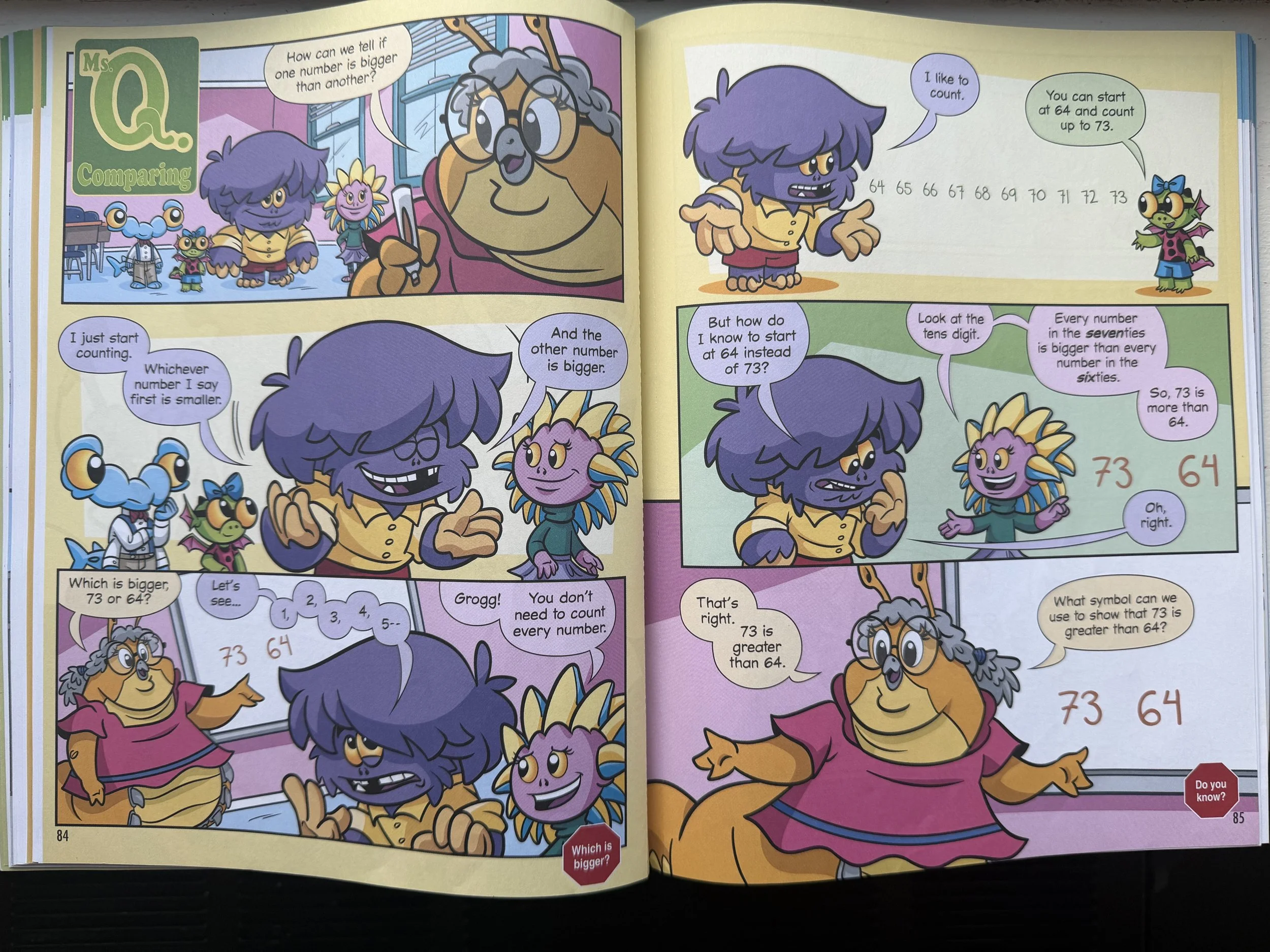
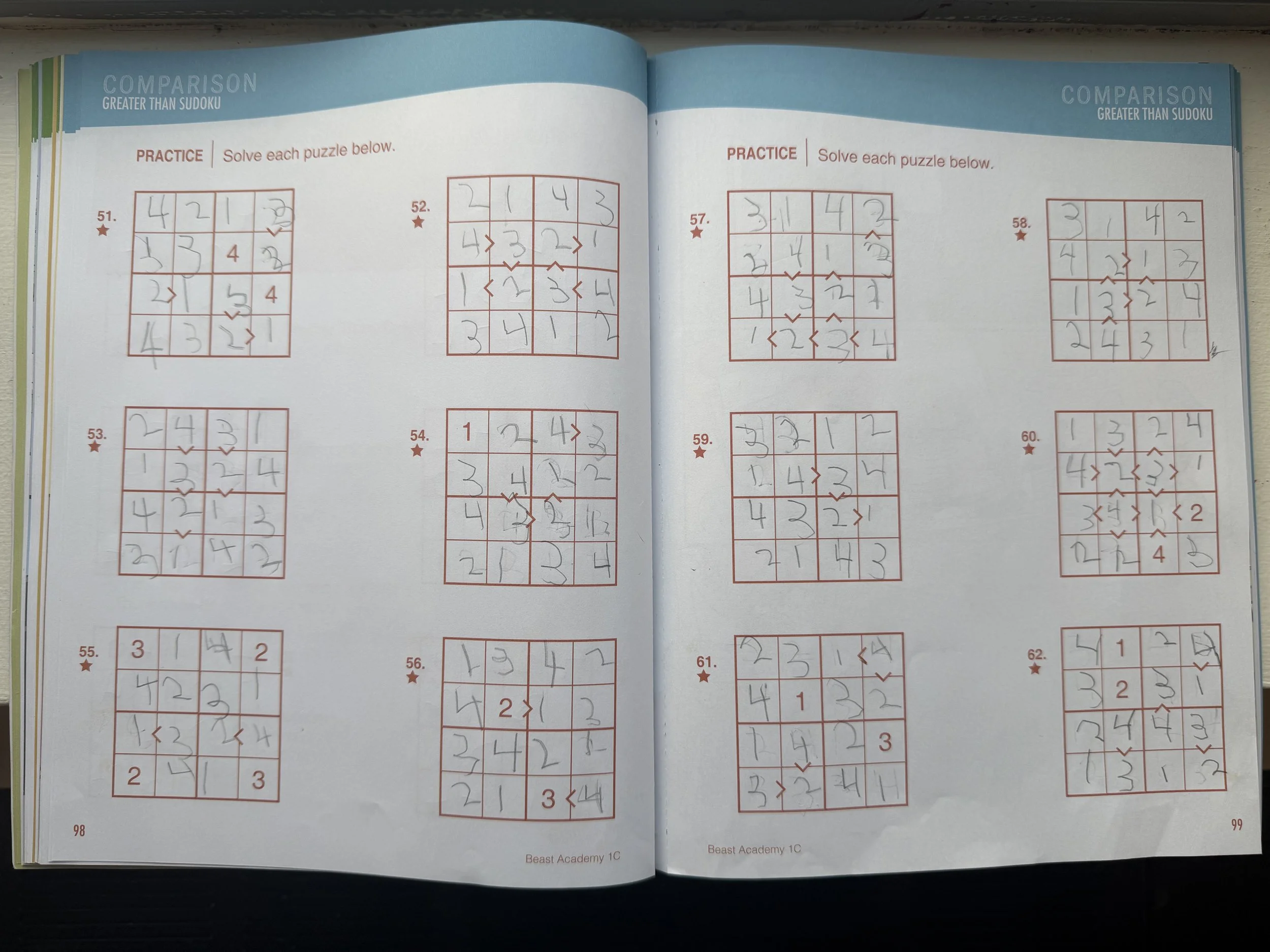
Finally, after multiple friends and gifted specialists recommended Beast Academy, we decided to try. We use the workbooks, not the online videos. I was skeptical about the comic style at first and avoided it because of this. However, it turned out my son loves the comics. He loves reading and being read to, so the stories are so fun for him. We will be walking, and he randomly starts talking about the Beast Academy characters. He is motivated to get through problems to get to more stories. The problems themselves are so engaging as well. There are some straightforward math problems, such as just adding and subtracting, but far fewer than in Singapore, for example. Instead, Beast Academy moves quickly to challenging and engaging puzzles. Many of the puzzles are actually fun for me to complete as well. They offer the challenge my gifted son needs and have children thinking deeper about numbers. They are similar to the challenge problems we saw in Singapore that initially drew me to Singapore, but there are many more of them. Beast Academy is such a unique curriculum, and for a child who is good at math and loves math, it is amazing. My husband, his brother, and I have all said we wish this were what we had as children.
Beast Academy also has regular and challenge problems. I would consider many (though not all) of the regular problems to be at a higher level than I saw in other curricula. Some of the challenge problems are surprisingly challenging. They really do require a deeper understanding. The shapes unit I found particularly challenging.
Beast Academy is not as hands-on as any other curriculum we tried. It doesn’t use a bunch of manipulatives and skips to the pictorial representation step. My son has a lot of experience with manipulatives and concrete math, particularly from Montessori math. That foundation, I believe, is critical. At the point we started Beast Academy, he was ready for more abstraction. I would not start Beast Academy with a child who is not ready for abstraction. Of course, you can always pull out manipulatives to teach and model the pictures in the stories, but that is not the design of the curriculum. As we move through Beast Academy, however, I could definitely see times I may choose to grab manipulatives for the teaching. It is of note that Beast Academy begins at the first-grade level. Though some of the math is taught in Kindergarten, it is generally taught in a much more concrete way in the Kindergarten year.
For Beast Academy, you only need the combined workbook/teacher’s guide for level 1. I believe level 2 breaks them up, and the workbook is no longer in color (ugh!). There are four books per year (1a, 1b, 1c, and 1d). I find this the most straightforward of all the curricula!
While I do not think a child needs to be gifted in math to enjoy Beast Academy, it is going to be a much better fit for a child who loves puzzles and is ready for a challenge. I know some families who use Beast Academy after completing a different curriculum for the year as a deeper dive. This can work well since Beast Academy is less hands-on.
The Lowdown
So, what’s the final verdict? In our home, we are continuing with Montessori math alongside Beast Academy. I did plan to continue with All About Math, but as we neared the end of level 2, I decided we would not continue on, at least for now. It was too teacher-intensive in addition to all the other things we are doing (including All About Reading with my daughter). I may continue to pull some games, and I will probably bring it back out when we reach the money and clock units in Beast Academy. I feel that All About Math had great games for that! I am so grateful we did All About Math when we did, and it served an amazing purpose! As for Singapore, I still pull some of the worksheets for my son for easier independent work. That said, I am not sure I will buy their second-grade materials.
What is right for you might be different! If you are looking for very solid math for a young child, Montessori math is fantastic. If you don’t care for open and go, you can stick with that or combine it! If you are looking for hands-on, minimal writing, well-rounded, but gentle math, Math With Confidence is a great option. If you are looking for an even more hands-on and low writing option that moves a bit faster, All About Math is excellent. If you are looking for more straightforward, very well-tested, and highly-regarded math without fluff, Singapore Math is a good option. If your child loves puzzles and is strong in math, Beast Academy is amazing.